Thứ Tư, 22 tháng 6, 2011

Italy -- Pesaro Jewish heritage route is on again this summer

Pesaro synagogue. From www.pesarocultura.it


By Ruth Ellen Gruber

Once again, visitors to Pesaro (and locals, too, of course) this summer will be able to visit  Jewish heritage sites around the city. Though unfortunately they seem to be open only on Thursday afternoons between June 23 and September 1.

Sites include the old Jewish quarter, the synagogue, whose complex includes a mikvah and a matzo oven, and the old Jewish cemetery.

For information on the synagogue, call: +39-0721 387541-474
For the Jewish cemetery: +39-335 1746509

Thứ Ba, 21 tháng 6, 2011

Nice article in the Forward on overlooked Jewish heritage sites

Wonderful carved stone in Siret. Photo (c) Ruth Ellen Gruber

By Ruth Ellen Gruber

Michael Luongo has a nice wrapup in The Forward about the "Top 10 Overlooked Jewish Heritage Sites From Around the Globe." It's called "Forgotten History." And thanks, Mike for mentioning this blog!

When most of us think of Jewish heritage travel, places like Jerusalem or the Warsaw Ghetto come to mind. Yet, from the pre-Inquisition sites that dot Spain, to farming villages in South America, hundreds of forgotten or under-visited Jewish sites exist across the world. When we put out the call for recommendations of our readers’ favorite overlooked sites on the Forward’s Shmooze blog and Facebook page, we got a global range of answers. Not surprising, most of the suggestions were about Eastern Europe. From your recommendations and my own travels, here’s an informal list of the top 10 Jewish sites often overlooked by traveler

The sites on the list range from Europe, to Latin America to New Zealand.....

It's always hard for me to choose a favorite or "best" or "most overlooked" site -- but I nominated my beloved Jewish cemeteries and painted synagogues in northern Romania and western Ukraine.

Thứ Hai, 20 tháng 6, 2011

Tourism -- An interesting essay on tourism to Jewish sites by Alex Joffe

By Ruth Ellen Gruber

There is an interesting essay in Jewish Ideas Daily about ebbs, flows and other "dilemmas" in Jewish-themed tourism, written by Alex Joffe, who is described as a research scholar with the Institute for Jewish and Community Research. He starts from considering the archeological remains of an ancient synagogue in Albania, excavated as a potential tourist site seven or eight years ago, but now languishing and all but abandoned.

Tourism, he writes, "is not just a recreational and aesthetic experience for the tourist. It is a business, and as such it poses moral questions as to the specific experiences that are bought and sold." 

Some of the issues he raises are among those I discussed both in the introduction of Jewish Heritage Travel and in the chapter on Travel in Virtually Jewish: Reinventing Jewish Culture in Europe. Such as the role of actual living Jewish communities in far-flung places, and whether or not visiting Jewish heritage sites entails any particular responsibilities or sensitivities.
Even among the dead, the ethical questions are real, and the ironies are evident. While Albanians had hoped to use their commendable historical story to draw tourists, their synagogue now languishes and decays. Meanwhile, Nazi concentration and death camps, above all Auschwitz, are sites of pilgrimage and remembrance—and a source of significant tourism revenues to Germany and Poland.

Why go one place rather than another? Albanians saved "their" Jews—are they owed something in return by Jewish tourists? Or should Jews instead visit Germany and Poland, to keep the Jewish histories of those countries from falling victim to the Nazis, to rebuild Jewish life, or even to offer prayers at cemeteries?

The scale of the problem is overwhelming, as there is no end to Jewish heritage sites. Everywhere Jews lived, they left behind schools and synagogues, dwellings, markets and factories, and cemeteries. Few of these sites are beautiful. Proportionally, sand-floor synagogues in Curaçao are vastly outnumbered by destroyed or usurped synagogues in Ukraine or Belarus. And everywhere there are the cemeteries, mass graves, and other assorted killing fields—overgrown and forgotten, ploughed up, or routinely desecrated. Another responsibility thus looms, to preserve the dignity of the Jewish dead.

But the synagogue of Onchesmos deserves to be seen—and not only by Jews. After all, remembering that Jews were a vital part of the Mediterranean world is, if nothing else, important to understanding that they remain a living part of that world today. Archeologists have responsibilities as well, not only to preserve the remains but to present them in such a way that they become at least a small part of the living present. Otherwise they should be left in peace.
I'm not sure that I find the questions and challenges (if they are really questions and challenges) he brings up mutually exclusive. There is no "should" entailed in where anyone -- Jewish or not -- chooses to visit.  Jewish heritage places are interesting and important in themselves -- in different ways. Each one tells a different story, though, of course, some of the stories are related. But it seems besides the point to make it seem an ethical choice -- or to pose it in terms of making it an ethical choice -- as to whether you will visit Auschwitz or the excavated ruins of an ancient synagogue in Albania.

(Oh, and I disagree with him when he says few of the sites Jewish "left behind" are beautiful.)

Poland -- the Chassidic Route: Sanok

Painting in Judaica exhibit at Open Air Museum.

By Ruth Ellen Gruber

Sanok, in the far southeastern tip of Poland, is a charming little town centered around a castle and nice little main market square -- it is a gateway to the Bieszcszady mountains, a beautiful region of lush hills, rushing streams and all the bucolic beauty that goes with it. I was there to write about the project constructing a replica of the destroyed Gwozdziec wooden synagogue -- and I've already posted on this.

Sanok - main square. Photo (c) Ruth Ellen Gruber


But, because of its long, rich Jewish history, Sanok, where Jews settled in the 16th century, is a stop on the Chassidic Route traced by the Foundation for the Preservation of Jewish Heritage in Poland, or FODZ. The town was a center of Chassidism in the 19th century, and before the Holocaust, Jews made up between 40 ad 50 percent of the local population.

There are only a few traces left of this vivid world.

The most interesting is the small but valuable collection of Judaica,  photographs, paintings and other material housed at Sanok's open-air folk architecture museum, or skansen, a sprawling display of wonderful wooden village architecture.


Photos (c) Ruth Ellen Gruber

It's all displayed in a long, bright room in a complex of buildings housing examples of Christian folk art, including carved wooden figures, and centuries-old icons.

Among the skansen buildings are a couple of houses once owned by Jews. But the museum director told me that there were plans to build a replica of one of the destroyed wooden synagogues -- the 18th century synagogue of Polaniec, for which ample documentation survives. The replica, (if and) when built, will form part of a newly built replica of a smalltown market square which is to open this summer.

Polaniec wooden synagogue. Picture from virtual shtetl web site

Sanok -- unfinished replica of market square. Photo (c) Ruth Ellen Gruber

In town, there are a couple of synagogue buildings, rebuilt for other purposes. There is also one surviving Jewish cemetery, dating from the 19th century -- it's next to the Catholic cemetery. Only a few gravestones remain. There is also a Holocaust memorial.

Jewish cemetery, Sanok. Photo (c) Ruth Ellen Gruber

Thứ Bảy, 18 tháng 6, 2011

Poland -- the Chassidic Route: Baligrod

My car is parked at the entrance to the cemetery, pointing back toward the village. It was a bit tricky turning around. Photo (c) Ruth Ellen Gruber

By Ruth Ellen Gruber

The  village of Baligrod, about 20 km south of Lesko, is another stop on the Chassidic Route itinerary sponsored by the Foundation for the Preservation of Jewish Heritage in Poland (FODZ).

Jews lived here from the early 17th century and for much of the period between the 18th century and World War II they made up a majority of the residents. The synagogue and other buildings were destroyed in WWII.

The Jewish cemetery survives on a hill overlooking the town — a lovely spot with a beautiful view -- and the narrow, bumpy dirt road is clearly marked by signposts from the village. I drove up (as I didn't know how far it would be) but it would make more sense to park below and walk.

Photo: Ruth Ellen Gruber

There are supposed to be about 200 stones here;  the oldest legible date from  1718 and 1732. The Nazis used hundreds of gravestones  to pave the market square -- they are believed still to be there, covered by asphalt.


The cemetery was restored in 2008, and the stones are in good condition — and there is even an incongruous red trash can for visitors to deposite rubbish (it was filled with  used plastic water bottles) –  but when I visited the grass and weeds were chest-high , in sore need of cutting. The grass totally obscured some of the stones -- I tried to see as many as I could, but I know I didn't see them all.

Photo (c) Ruth Ellen Gruber

Still, I found many beautifully carved stones, with a variety of candlestick shapes on women's stones, ranging from crude but delicate incised images to more elaborate styles, some featuring candlesticks flanked by birds. See more candlesticks stones at my candlesticksonstone.wordpress.com site.

Photo (c) Ruth Ellen Gruber

Someone had clearly visited a short while before I did, though, as there were narrow paths tromped through the grass, and someone had piled stones and pebbles on many of the gravestones.

Photo (c) Ruth Ellen Gruber

Thứ Sáu, 17 tháng 6, 2011

Ah Yong Restaurant at Shuishe, Sun Moon Lake - Taiwan

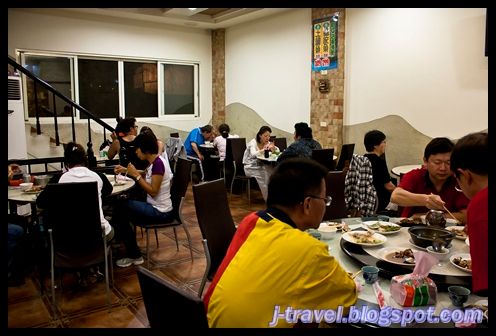
Ah Yong Restaurant (N23.86494 E120.91155) is located along the street at Shuishe town. We were bought to this restaurant by our driver (Mr Yew) and all dishes are serve and cook in Ita Thao's recipes. Ita Thao is one of the Taiwanese Aborigines, we visited their village in the next day and I will blog about it later...

Ah Yong Restaurant

The restaurant is Famous with the fish below...

I don't know how to call it in English...

All dishes were ordered by our driver, and served on table very fast!
Before we start our dinner, the lady boss came to introduced every dishes from the restaurant...and she claimed that the fish (below) are only available in this restaurant, we can't get elsewhere in the whole of Taiwan! Really?!

The Special Fish of Ah Yong Restaurant

Mixed vegetables and mushroom

Pork Knuckle (Ita Thao recipe) DELICIOUS!

Cold Steam Chicken

Mushroom soup

Vegetables

Pork

All dishes were Delicious and I like it very much! Especially the fish, steam chicken and the pork knuckles! All of us satisfied with the Special recipes of Ita Thao and I MISS the taste Very Much!

If I will have a chance to visit Sun Moon Lake again, I will DEFINITELY dine in Ah Yong Restaurant!

Related post :-
*  My Taiwan Trip on May, 2011

Location map of Ah Yong Restaurant at Suishe, Sun Moon Lake - Taiwan


Poland -- More on the night of the synagogues and Krakow

Sign for the Krakow JCC and a tourist map of Jewish sights in Kazimierz. Photo (c) Ruth Ellen Gruber

I wrote my latest Ruthless Cosmopolitan column on the revival of Jewish spirit in Krakow, following my participation in the Night of the Synagogues -- and a conversation I had with Jonathan Ornstein, the director of the Krakow JCC, the morning after.....We both needed caffeine..... I  posted about the Night of the Synagogues last week on my this blog -- with lots of pictures.


By Ruth Ellen Gruber

June 15, 2011

KRAKOW, Poland (JTA) -- Jews in Krakow have a new slogan -- "Never Better."

The catchphrase is deliberately provocative, a blatant rejoinder to "Never Again," the slogan long associated with Holocaust memory and the fight against anti-Semitic prejudice.

It may be counterintuitive, acknowledges Jonathan Ornstein, the American-born director of Krakow's Jewish community center who helped come up with the slogan.

But it's aimed at rebranding Jewish Poland, or at least Jewish Krakow, shaking up conventional perceptions and radically shifting the focus of how the Jewish experience here is viewed.

"Because the Holocaust isn't subtle, then the rebranding, as a way to get people to understand the situation here now, also can't be subtle," Ornstein explained.

Only a few hundred Jews live in Krakow, but the community has been rebuilding in the past two decades, particularly since the JCC opened three years ago.

"When we say 'Never Better,' it's not in terms of numbers, or the amount of things in Jewish life, or the synagogues that are functioning and all that," Ornstein said.

However, he went on, "in terms of the way the Jewish community interacts with the non-Jewish community and the direction that things are going, I think that there's never been a more optimistic time to be Jewish in Krakow than there is now."

I spoke with Ornstein on a Sunday in June, the morning after an unprecedented event that in a way had been a public affirmation of the new Jewish spirit he described.

Organized by the JCC, the American Jewish Joint Distribution Committee and the Krakow Jewish communal organization, it was called 7@Night -- Seven at Night or the Night of the Synagogues.

Night of the Living synagogues may have been a better description.

From 10:30 p.m. until 2 a.m., all seven of the historic synagogues in Krakow's old Jewish quarter, Kazimierz, were open to the public.

It was part festival, part celebration and part didactic exercise. The aim was to foster Jewish pride, but also to educate non-Jewish Poles about contemporary Jewish life and culture.

An astonishing 5,000 or more people turned out, a constant flow of people that trooped from one synagogue to the next and patiently braved long, slow lines and bottlenecks at doorways. Almost all were young Cracovians.

Each synagogue hosted an exhibit, concert, talk or other activity that was produced by Jews and highlighted Jewish life and culture as lived today in Poland, Israel and elsewhere.

Events ranged from talks by Krakow Rabbi Boaz Pash on "the ABCs of Judaism" to a live concert by an Israeli rock band to a DJ sampling new Jewish music from a console set up on the bimah of the gothic Old Synagogue, now a Jewish museum, to a panel discussion about the role of women in Judaism.

All the events were free -- and all were full.

"It far, far exceeded our expectations," said Ornstein.

I've never seen anything quite like it, even though I've followed the development of Kazimierz for more than 20 years -- from the time when it was an empty, rundown slum to its position now as one of the liveliest spots in the city.

I've witnessed -- and chronicled -- the development of Jewish-themed tourism, retail, entertainment and educational infrastructure in Krakow, including the Jewish Culture Festival that draws thousands of people each summer. And I've written extensively about the interest of non-Jews in Jewish culture.

But Seven at Night was something different. For one thing, nostalgia seemed to play no role. And also, unlike many of the Jewish events and attractions in Kazimierz, this one was organized and promoted by Jews themselves.

It was their show, kicking off with a public Havdalah ceremony celebrated by Rabbi Pash that saw hundreds of people singing and dancing in the JCC courtyard.

"Never Better" was a prominent theme.

Most explicitly, it was the title of a multimedia presentation that ran throughout the night, projected on the vaulted ceiling of the 16th century High Synagogue, which today is used as an exhibition hall. The presentation featured interviews with local Jews young and old, religious and secular, all expressing a confidence in their identity and future.

It's still anybody's guess whether or not demographic realities will enable the long-term survival of a Jewish community in Krakow. But Ornstein said that may not be the point.

A key message of the current activism, he said, was to help frame the context of Polish Jewish history and hammer home that however small their numbers, Jews in Poland are not a separate, exotic entity but part and parcel of 21st century Polish society.

"The powerful message is that Judaism isn't just an idea, it's not just something that belongs to the Polish past, but there are Jews living here," Ornstein said. "We're trying to say that you can be a Jewish Pole, not just a Jew in Poland, to turn 'Jew' into an adjective instead of a noun."

I hope he's right.

Bài đăng phổ biến